
Skip to content
By Stakeholder
Gain control over your AP and maximize card spend

Automate your AR with the safest payment option available

Expand commercial card programs for your clients

Work with us to add B2B payments to your offerings
By Technology
Pay 100% of your suppliers by card, 100% of the time

Patented straight-through processing technology

Patented rules-based payment engine

Navigate Visa's latest commercial card data rules with confidence
By Geography
Payment solutions within the continental U.S.

Pay suppliers in 180+ countries with your U.S.-issued card

Use your locally-issued card across our global network

Read up on the latest global insights from Boost
We optimize the use and acceptance of commercial cards

Learn about our team

Read about Boost in the news

Join one of the fastest-growing B2B Fintechs in the U.S.

Navigating Visa’s Commercial Enhanced Data Program (CEDP)

Disclaimer

This document is for informational purposes only and reflects Boost Payment Solutions’ interpretation of Visa’s Commercial Enhanced Data Program (CEDP) based on publicly available information and industry feedback.

Boost Payment Solutions is not affiliated with, endorsed by, or sponsored by Visa Inc. The content should not be considered legal, financial, or compliance advice. Companies should perform their own independent review and due diligence before implementing any CEDP-related processes or relying on the information provided, as actual requirements and outcomes may vary based on individual circumstances and transaction data.

What is CEDP?

Visa’s Commercial Enhanced Data Program (CEDP) is fundamentally changing how B2B card payments are qualified, validated, and priced. The program replaces the legacy Level 2 and Level 3 interchange structures with a data driven model that rewards accuracy and transparency. CEDP replaces the Large Ticket/Level III interchange tables that have previously provided the lowest published rates available for qualifying commercial card transactions. Under CEDP, rate qualification now depends on three key factors:

  • Participation in the CEDP program, through an additional fee of 0.05% for every submitted transaction.
  • The quality of each transaction’s data, ensuring all required fields are accurately formatted and transmitted. Missing or incorrect data results default to the standard, higher rate.
  • The merchant/supplier’s verification status, confirming their ability to consistently support enhanced data standards over an extended period of time. Unverified merchants are processed at higher rates until Visa validation is complete, with rate adjustments issued up to 90 days later.

THE IMPACT

If you currently accept Visa commercial card transactions and your processor is not ready to meet the new CEDP data requirements, your interchange rate could go up by over 1.3%.


CEDP Interchange Rate Structure
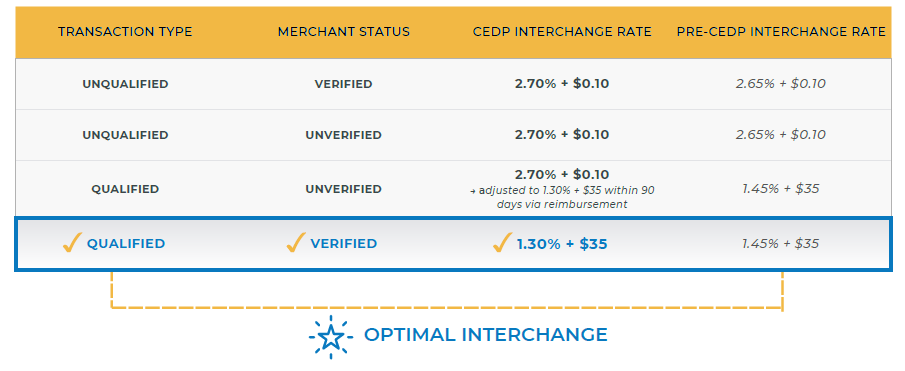
cedp interchange rate structure

interchange rate example


Qualified vs. Unqualified Transactions

At the heart of Visa’s Commercial Enhanced Data Program (CEDP) is one principle: your data determines your rate. Every commercial card transaction will now be classified as either qualified or unqualified, based on the quality and completeness of the data submitted. These enhanced data requirements replace the old Level 2 and Level 3 structures entirely starting April 2026.

In other words, the more precise and consistent your transaction data, the better your rates. CEDP replaces what used to be a checkbox exercise with an active validation model, where Visa’s systems evaluate every transaction automatically as it happens.

qualified vs unqualified


Verified vs. Unverified Merchants/Suppliers

Once transactions are categorized as qualified or unqualified, Visa also verifies the supplier's merchant account based on their ability to consistently submit accurate, compliant enhanced data over time. Even with all the right data, payments may get charged a higher interchange rate at the time of transaction and receive a credit or adjustment in the future, resulting in costly delays for your business. Under its standard CEDP program, Visa is only offering preferred CEDP rates at the time of transaction to merchant accounts that they have been pre-verified. Verification is continuous which means poor data quality can lead to temporary loss of Verified status.verified vs unverified
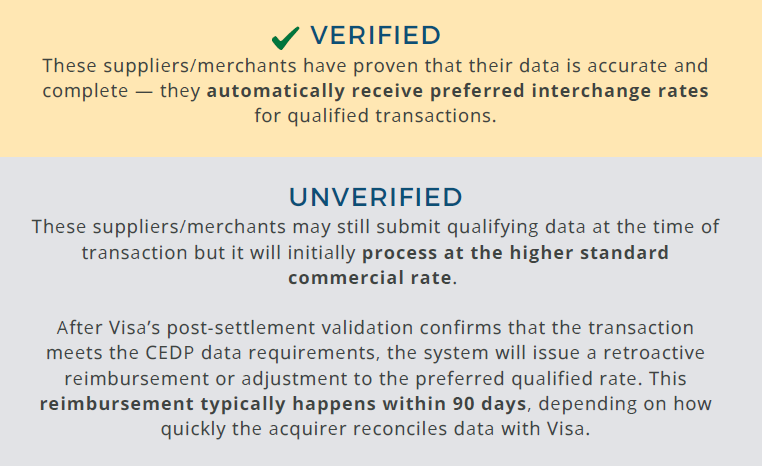
 

How Verification Works

Under CEDP, verification depends on how accurately enhanced payment data moves through the entire payment chain — from the supplier, through their acquirer, to Visa. Each participant plays a key role in ensuring that transactions are complete, compliant, and eligible for preferred CEDP rates.

1. Merchant/Supplier

Each transaction, whether buyer- or supplier-initiated, must include complete, accurate data to qualify under CEDP. If that data is missing or inconsistent, transactions can be marked unqualified — leading to higher interchange fees and delayed verification for the merchant/supplier.

2. Processor 

Processors and acquirers are responsible for sending enhanced data to Visa in the correct format. If the data is dropped or misformatted, even valid transactions can fail qualification, resulting in delayed verification status and higher interchange rates for the merchant/supplier.

3. Visa

Visa reviews every transaction using machine learning to check data accuracy and completeness. A history of qualified transactions is required for Visa to verify the merchant/supplier, making them eligible for preferred CEDP rates at the time of transaction.

Assessing your impact

Visa’s CEDP affects every link in the B2B payment chain — from AP and AR optimization companies to acquirers, merchant service providers, and embedded software platforms. The degree of impact  depends on how your organization captures, formats, and transmits enhanced transaction data today.

As a merchant, you are likely impacted if your business:

  • Accepts or processes Visa commercial card transactions

  • Relies on manual processes or multiple data entry points to pass invoice or item-level information.

  • Uses an acquirer or processor that hasn’t confirmed CEDP readiness or can’t validate data in Visa’s new schema.

  • Uses legacy ERP or gateway systems that don’t automatically format or transmit enhanced data.

Impact across the ecosystem

While the shift introduces new complexity, it also creates an opportunity for better visibility, control, and cost efficiency in B2B payments. Working with a partner equipped to automate data capture, validation, and formatting is now essential to stay compliant and cost-competitive. 

Below, we break down the key challenges and implications for each audience—and what to look for in a partner to ensure every transaction is qualified, compliant, and CEDP-ready from day one.
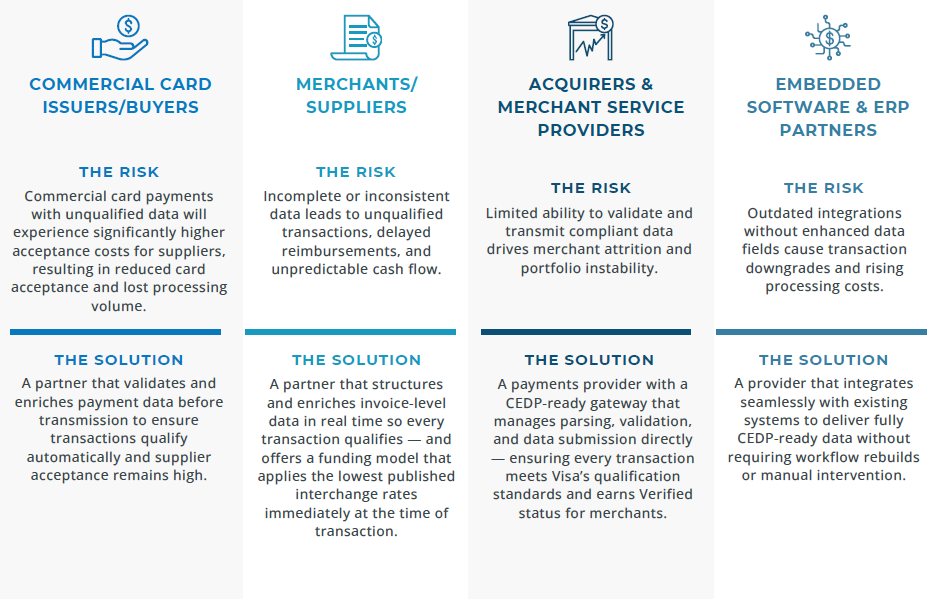
impacts across the ecosystem


Preparing for what comes next

CEDP is just the beginning of a broader shift
toward real-time validation and dynamic pricing across the B2B payments landscape.

Businesses that act early will be better positioned to stay compliant, efficient, and cost-stable as networks continue raising data standards.

Steps to take now:

✅ AUDIT YOUR DATA FLOWS:  Identify where enhanced data might be incomplete, inconsistent, or manually entered.

✅ ENGAGE YOUR ACQUIRER: Confirm they’re ready for CEDP and can transmit enhanced data in the required format.

✅ AUTOMATE YOUR PROCESS: Replace manual touchpoints that increase error risk and slow down validation with technology such as Straight-Through Processing (see p.10.)

✅ EDUCATE YOUR TEAMS: Finance, IT, and procurement all play a role in maintaining accurate, compliant data.

✅ WORK WITH A PROACTIVE PARTNER: Choose a provider that’s already aligned with Visa’s enhanced data standards and can help you stay ahead as those standards evolve.

Automating CEDP verification through Straight-Through Processing (STP)

Straight-Through Processing (STP) is a mechanism that automates the end-to-end processing of transactions. For commercial card payments, STP can enable an Issuer or Buyer to push card payments directly to a Supplier's acquiring bank, eliminating the manual entry of card information traditionally received via email or fax.

BEFORE STP

Manual virtual card payments often require AR teams to retrieve card details from emails, portals, or files, enter them into their system, and reconcile the payment afterward.

This manual process increases the risk of missing or inconsistent enhanced data, making transactions more likely to be unqualified under Visa’s CEDP — leading to higher interchange fees, delayed reimbursements, and compliance risk.

AFTER STP

With the right STP technology, card payments can move seamlessly from the buyer or issuer to the supplier’s acquirer— no manual entry, no data gaps. STP technology can automatically parse, enrich, and validate the enhanced data required for CEDP qualification in real time, ensuring every transaction is accurate, verified, and compliant before submission.

THE CATCH?

Not every provider offers true STP. Many systems still rely on manual file uploads, partial automation, or batch reconciliation — all of which can compromise data accuracy and delay qualification.

That’s why it’s critical to partner with a provider that offers true end-to-end STP technology capable of delivering fully CEDP-ready transactions from the start.

Purpose-built with STP with Boost Intercept®

Boost has long been a trusted partner to card networks and financial institutions, helping set the standard for enhanced data integrity and secure B2B transaction processing. This means that Boost customers don't have to take any action to meet CEDP qualifications since data cleansing and validation are automatically included in all transactions proceed by Boost Intercept, our multi-patented straight-through processing platform. Boost completely automates the complex process of parsing, enriching, and validating enhanced transaction data, ensuring every payment is compliant and CEDP-ready without requiring system overhauls or operational disruption.

HOW IT WORKS

Step 1: The supplier issues an invoice to the buyer
Step 2: Buyer approves the invoice and triggers virtual card payment instructions to the Boost Intercept platform
Step 3: Boost Intercept processes the payment while parsing, standardizing, and enriching transaction data in real time. Every required field for CEDP qualification is validated and complete, ensuring the transaction qualifies for optimized interchange rates
Step 4: Boost delivers enhanced remittance data directly to the supplier’s ERP or accounting system in their preferred format, simplifying reconciliation and maintaining full CEDP compliance
Step 5: The supplier receives payment as funds are deposited directly into their DDA
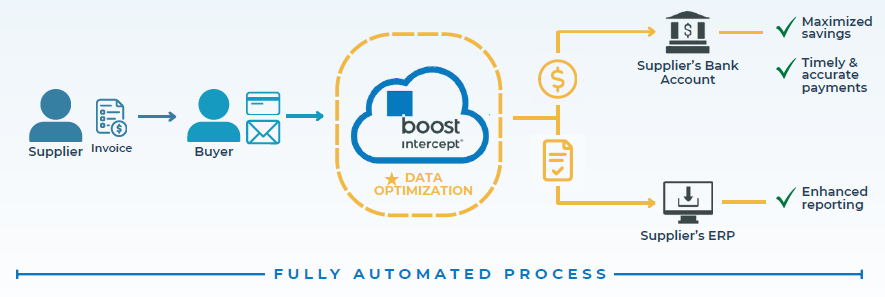
boost intercept fully automated process flow


THE SOLUTION

With Boost, you can feel confident knowing your transactions are fully CEDP-ready

Boost is committed to providing qualifying data so all our customers will default to the lowest published rates available at the time of transaction*.

And, unlike other providers who delay rate adjustments until Visa’s verification cycle is complete, Boost’s pre-funding model ensures that customers benefit from qualified rates immediately*, protecting cash flow and eliminating costly reimbursement delays of up to 90 days.

ADVANCED PAYMENT PARSING

Our technology reformats and validates data to meet Visa's requirements before submission

AUTOMATED DATA ENRICHMENT

Every transaction includes all required enhanced data fields, validated in real time

END-TO-END AUTOMATION

Boost Intercept , our straight-through processing solution, removes the cost and risk associated with manually-processed transactions

BACK BY EXPERTS

Our B2B specialists actively monitor Visa's evolving standard to ensure you are always ready for what's next

*Boost will default to the lower CEDP  interchange rates at the time of the transaction pending a determination as to  whether Supplier qualifies for lower CEDP pricing. If it is determined that Supplier does not qualify for CEDP rates, Supplier will owe to Boost, and Boost is authorized to recoup from Supplier, an amount equal to the difference between the uncollected higher standard interchange rates. See full terms and conditions for additional details.

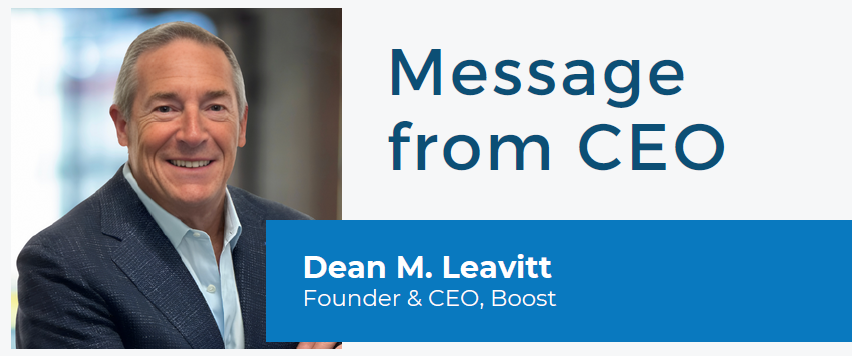
Message from CEO Dean M. Leavitt

“CEDP is not just another compliance requirement; it is a glimpse into the future of commercial payments, one where data integrity, intelligence, and partnership define the winners.”

There’s been no shortage of buzz around Visa’s new Commercial Enhanced Data Program, or CEDP. It is reshaping how commercial card transactions are submitted, verified, and priced, and more importantly, it is forcing the entire ecosystem to evolve.

At Boost, we have been preparing for this change well in advance. Our systems have been designed to capture, enrich, and submit authentic invoice data for years. We have already implemented the necessary adjustments across our infrastructure to ensure every transaction we process includes genuine line-item data mapped directly to the invoice. This readiness gives our clients peace of mind knowing they will continue to qualify for the most favorable interchange possible under the new rules.

But readiness isn’t universal. Many players in the ecosystem are still scrambling to adapt, which means their suppliers may experience higher costs, delays in rebates, or reconciliation challenges as Visa classifies which merchants meet the new data standards. That is where things can get complicated. Even if a supplier’s transactions ultimately qualify, Visa’s process involves issuing rebates weeks after the fact, once they’ve confirmed the transaction’s qualified status. For suppliers managing cash flow or working capital, that lag can last up to 90 days and introduces friction that did not exist before.

To simplify this, Boost is proactively funding our suppliers as if all of their transactions have already been qualified by Visa. In other words, we are providing the benefit upfront rather than making them wait for a rebate weeks down the road. It is a cleaner, more predictable experience for suppliers, and it aligns with our philosophy that modernization in B2B payments should simplify, not complicate, financial operations.

There is also a broader point here that’s worth paying attention to. CEDP is more than a rule change; it is a signal. It represents a growing recognition from the networks that commercial payments are not a side business. They are a massive, foundational component of the global economy. The numbers tell the story: B2B payments total more than $120 trillion worldwide, far surpassing consumer payments. That is not just an opportunity; it is a responsibility for the industry to ensure that the infrastructure supporting those transactions is efficient, secure, and transparent.

Change often comes with friction, but it also comes with opportunity. The companies that adapt quickly, those who invest in automation, accuracy, and trusted partners, will not only weather the shift but thrive in it. CEDP is not just another compliance requirement; it is a glimpse into the future of commercial payments, one where data integrity, intelligence, and partnership define the winners.

Sincerely, 

Dean-Signature


Download This eBook