


For many finance and accounts receivable (AR) teams, collecting payment is only half the battle. The real operational work begins after the payment arrives, figuring out which customer paid, what invoice it belongs to, and how to record it correctly.
This process is known as cash application, and it’s one of the most important steps in the B2B payments lifecycle. When done well, cash application keeps financial records accurate and accelerates the order-to-cash cycle. When done poorly, it can create reconciliation headaches, delayed reporting, and strained customer relationships.
In this guide, we’ll break down:
- The steps in the cash application process
- Why it matters for accounts receivable teams
- Common challenges in B2B cash application
- How automation and straight-through processing can transform the process
What Is Cash Application?
Cash application is the process of matching incoming payments from customers to the correct invoices in a company’s accounts receivable system.
The typical cash application process includes:
- Receiving payment from the customer
- Reviewing remittance information (invoice numbers, payment details, etc.)
- Matching the payment to the appropriate invoice(s)
- Applying the payment within the accounting or ERP system
- Closing the invoice and updating the customer’s account balance
This step is essential for accurate financial records. Without it, a business cannot clearly determine which invoices are paid, which are outstanding, or how much cash has actually been collected.
Cash application sits at the heart of the accounts receivable function.
Why Cash Application Matters in B2B Payments
In B2B payments, transactions are often large, complex, and tied to multiple invoices or purchase orders. That makes accurate payment matching critical.
Efficient cash application increases cash flow visibility, enabling companies optimize working capital management and make informed strategic business decisions. Let’s break this down even further:
1. Financial Accuracy
Cash application ensures payments are correctly applied to invoices, keeping financial records accurate and auditable. When payments are misapplied or left unapplied finance teams may struggle to reconcile revenue and track outstanding balances.
Accurate application also prevents customer disputes caused by invoices that appear unpaid when they’ve already been settled.
2. Faster Cash Visibility
Finance leaders rely on accurate AR data to understand cash flow and working capital. When payments are applied quickly, organizations gain better visibility into collected revenue and outstanding receivables.
This clarity helps businesses:
- Forecast cash flow more accurately
- Reduce Days Sales Outstanding (DSO)
- Make informed credit and collection decisions
3. Improved Customer Experience
Nothing frustrates customers more than being told they haven’t paid when they actually have. Accurate cash application ensures customer accounts reflect payments promptly, reducing billing disputes and improving trust between finance teams and their customers.
4. Operational Efficiency
Manual cash application consumes hours of accounts receivable working hours. Finance professionals often spend significant effort reviewing remittance emails, PDFs, spreadsheets, or bank statements just to identify which invoices were paid. Automating the process frees teams to focus on higher-value tasks like collections strategy or financial analysis.
The Challenges of Manual Cash Application
Despite its importance, many large enterprise businesses still rely heavily on outdated, cumbersome processes for cash application. Some common challenges include:
Inconsistent Remittance Data
Customers may send remittance information in a variety of formats:
- Email attachments
- PDF documents
- Spreadsheets
- Bank messages
- Online portals
Each format requires manual review and interpretation before the payment can be applied.
Multiple Payment Channels
Businesses today accept payments through many channels, including:
- ACH transfers
-
Wire payments
-
Checks
- Commercial cards
- AP portals
Each channel can produce different remittance data formats, increasing the complexity of matching payments to invoices.
High Volume
As organizations scale, manual processes simply can’t keep up. High invoice volume means more payments, more remittance files, and more reconciliation work for AR teams.
Seamless Cash Application Integration with Boost Intercept
One of the most powerful ways to improve cash application is by modernizing how payments are accepted. Boost enables companies to streamline B2B payment workflows through Boost Intercept, Boost’s patented Straight-Through Processing technology designed to automate commercial card acceptance.
As Stephen Masko, VP of Business Development at Boost Payment Solutions, explains:
“Most payment workflows force a tradeoff: improve the front end or increase back-end complexity. Boost Intercept removes that compromise by automating payment acceptance and pushing enhanced remittance data directly into ERP systems, enabling faster, more seamless reconciliation.”
How Straight-Through Processing Works
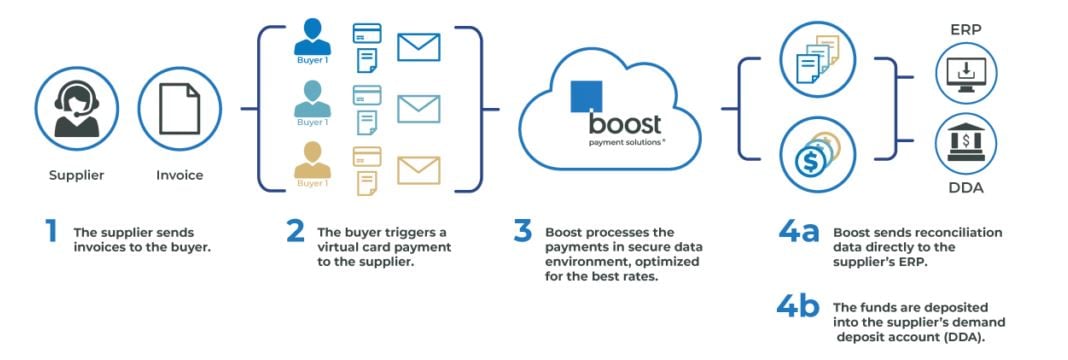
Boost’s Straight-Through Processing technology handles incoming B2B payments without manual intervention, delivering a touchless, automated experience from the moment a transaction is submitted through settlement in your bank account. Payments are delivered electronically along with enhanced remittance data, helping finance teams identify exactly which invoices are being paid.
In addition to automating payment acceptance, Boost Intercept provides enhanced remittance data that flows directly into existing cash application tools and ERP systems. This allows finance teams to quickly and accurately match payments to invoices without manual effort.
By removing friction at the point of payment while seamlessly integrating with downstream systems, Boost Intercept eliminates steps on the front end without adding complexity on the back end, creating a more efficient, end-to-end cash application process.
There is no new equipment or training required to implement Boost Intercept within your existing AR systems, making it easy for teams to improve cash application accuracy and accelerate cash flow.
The Future of Cash Application
As B2B payments continue to digitize, companies who use manual reconciliation processes aren’t able to efficiently manage and scale. Finance teams that modernize their cash application workflows by leverage commercial card acceptance gain significant advantages:
- Eliminating manual card processing
- Increasing cash application accuracy
- Accelerating the order-to-cash cycle
- Lowering operational costs
- Gaining better financial visibility
- Strengthening customer relationships
To sum it up, cash application is a critical step in the accounts receivable process. By leveraging automation and straight-through processing for B2B payments, finance teams can dramatically reduce manual work while accelerating cash flow.