

Trends Boost Experts Are Seeing in Enterprise Payments
B2B payment fraud is no longer primarily a transactional problem. It is an ecosystem risk.
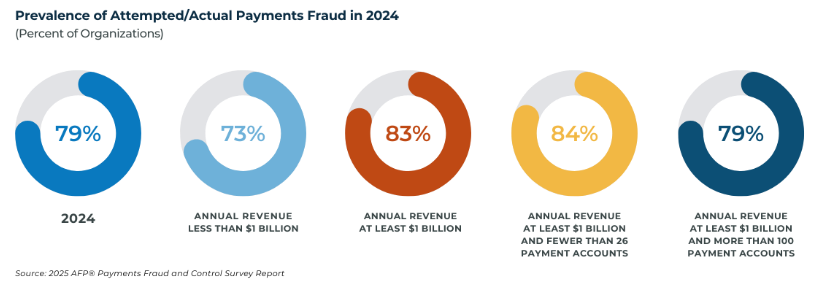
According to the 2025 AFP Payments Fraud and Control Survey, 79% of organizations reported being victims of attempted or actual payments fraud in 2024. That number has remained persistently high despite growing investments in compliance and controls.
The takeaway is not that companies aren’t trying. It’s that the nature of fraud has changed.
Based on what Boost’s security and payments experts are seeing across enterprise environments, three structural shifts are defining this next phase of risk.
1. Fraud Is Targeting Relationships, Not Just Transactions
Historically, fraud detection focused on transaction anomalies such as unusual dollar amounts, geographies or timing patterns.
Today, attackers are exploiting trust relationships. Boost’s Head of Security, Dr. Buddha Nepal, told CTMFile, “Payment networks are only as strong as their weakest supplier or service provider. Companies underestimate how quickly a compromise in their ecosystem can cascade. It's a balance sheet issue as much as a technical one.”
- Compromised vendors are being used to initiate legitimate-looking payment diversion requests.
- Business email compromise (BEC) remains one of the most cited attack vectors in corporate fraud reports, with AFP reporting that 63% of organizations experienced BEC in 2024.
- A disproportionate share of b2b payment fraud is concentrated around newly added payees, where onboarding controls are weakest.
The vulnerability is no longer just “Was this payment unusual?” It is “Was this relationship properly validated?” That is a structural shift.
2. Digital Acceleration Has Expanded the Attack Surface
Enterprises are digitizing AP and AR workflows to improve speed, automation and working capital visibility. But every API, integration and automated approval flow introduces additional exposure.
Static approval hierarchies and annual audits were designed for slower payment cycles. They are misaligned with real-time or near-real-time payment execution.
Security must now operate at the same velocity as payments.
That means:
- Continuous monitoring rather than periodic review
- Behavioral baselining rather than fixed rule thresholds
- Identity validation embedded within payment execution
Without that alignment, digitization increases efficiency and risk simultaneously.
3. AI Is Fueling Both Detection and Deception
Machine learning models can analyze millions of transactions in real time and surface patterns that traditional controls miss. That is a meaningful advancement.
However, fraudsters are leveraging AI as well.
- Synthetic identity construction is becoming more sophisticated and on the rise. This is where machine learning models assemble fragments of legitimate and falsified data to generate synthetic identities that can evade standard KYC (Know Your Customer) controls.
- Adaptive phishing campaigns refine messaging automatically.
- Deepfake-enabled social engineering is increasing the credibility of fraudulent instructions.
The result is not simply better tools for defenders. It is escalation.
What Enterprises Need to Do Next
If B2B payment fraud is now ecosystem-based rather than transaction-based, mitigation strategies must evolve accordingly.
1. Reassess Payee Onboarding Controls
Given the concentration of B2B payment fraud around newly added payees, onboarding workflows should receive heightened scrutiny. Identity verification and change-management validation must be embedded upstream, not reviewed after funds are released.
2. Elevate Payment Fraud to Enterprise Risk Governance
Fraud impacts liquidity, settlement timing and counterparty trust. It should be treated as a balance sheet issue, not solely an IT or compliance function.
3. Embed Security Within Payment Infrastructure
Controls that sit outside the payment workflow create delay and inconsistency. Risk scoring, validation and anomaly detection must operate inside the b2b payment engine to keep pace with execution speed.
4. Encourage Structured Intelligence Sharing
Fraud networks collaborate efficiently. Defensive networks often do not. Federated learning (FL) enables institutions to collaborate on fraud detection without sharing sensitive data. By training AI models on privacy-protected data from multiple organizations, FL helps identify fraud patterns early, something isolated models cannot achieve.
This approach allows organizations to contribute to collective defense, enhancing detection while keeping proprietary information secure.
The Bottom Line
The data is clear: fraud attempts remain widespread, and attack methods are becoming more coordinated and technologically sophisticated. Security in B2B payments must move from reactive compliance to embedded resilience.
At Boost Payment Solutions, that philosophy informs how our B2B payment infrastructure is designed. Security controls are integrated directly into transaction processing and validation workflows rather than layered on after the fact. This embedded model has enabled us to maintain a zero-fraud track record on transactions we process, while supporting scalable, automated payment environments.
In an ecosystem-driven B2B payment fraud landscape, resilience is not achieved through stronger gates alone. It is achieved through stronger design.